

Mountains do not like people.
That’s the first order of business. It sounds strange, I know. But hear me out.
I lived in Boulder, Colorado from 2004 through 2009. Although Colorado is one of the most beautiful of U.S. states, the alpine experience didn’t fully agree with me. That said, I wouldn’t trade what happened there for anything in the world. In particular, I’m referring to little known yet notable oddities concerning the great peaks. They are not at all what you think.
Listen:
The Rocky Mountains draw legions of exceptionally fit humans, such as hikers who wear T-shirts bearing the slogan, “Sea level is for Sissies,” who will claim, or assume, to have a relationship with the mountains. But the fact is, they don’t. If they did, they’d know better. This is not their fault. Most of the outer-directed are not equipped to receive the kinds of messages the mountains send out.
To such people, the Rockies are awe-inspiring locales in which to sport. But to those of us who are tuned in, who truly know what’s going on, it’s another story — a darker and more sinister one.
The mountains, if the truth be told, are narcissistic. They are haughty and self-congratulatory. A mountain is like a strikingly attractive person who refuses to give of him/herself simply because there will always be options. And, I can assure you, each and every one of the fifty-five 14,000-foot peaks in Colorado tends toward rude. One day I sensed Long’s Peak, a devastatingly gorgeous forteener, telling me to fuck off. And I was not even standing on it.
The problem is, we have been admiring them for too long. They know this. Which is why they take for granted their beauty and seek little understanding of the way it affects others.
As I said, I lived in Boulder, in the shadow of the Rockies, for a while. Boulder, as a town, is ideally suited for two kinds of people: 1) well-to-do young couples with children, and 2) a certain kind of athlete including skiers, cyclists, hikers, climbers and runners eager to exert themselves at altitude. I have envied the physiology of these types on many occasions. These seemingly wholesome folks, few people realize, spend their exercise-laden days as high as crack addicts, gorging on tidal waves of adrenaline yet professing to be mental and physical models of equanimity.
Not fitting into either category, I sometimes wondered what to do with myself in Boulder. So, when my buddy Tom offered to loan me his Suzuki 350 dual sport road and dirt motorcycle, I rushed out and got a license.
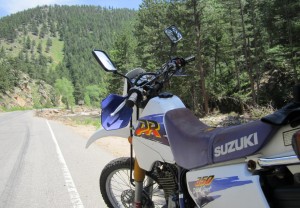 I rode the purple-and-white fun machine two glorious summers, motoring up into the canyons and backroads and endless dirt capillaries that snake through the Rockies. I sped along the Peak to Peak highway from Nederland to Estes Park with the sun at my back, jaw-dropping views at every angle and the wind sandblasting my face, creating a truly frightening hair phenomenon. I was a white Don King.
I traveled as many roads and trails as I could find. Bumping or speeding along, forgetting for a spell my life down at 5,430 feet, I let my mind mingle with the terrain. Often I would pull over and cut the engine and sit or stand in the total quiet. Sometimes I’d spot an interesting trail and veer onto it and ride as far as I could, or dared, go.
I drank in the beauty. I felt the majesty. Secretly I listened to their spare exchanges. But even as I began to open up to them, I had the impression they were lying in wait.
One afternoon they hit me with a torrential downpour and I rode grimacing in the knife-pelts of rain until I was unable to see ten feet in front of me. I pulled over, dropped the bike and crouched under a friendly tree until I was able to ride back down, sopping wet and freezing cold.
Their consciousness, of course, is far different than ours. It operates at a wavelength that is difficult to find, like a radio station that isn’t, say, 87.5 or 91.1 but more like 85.2234. But find it I did.
On the Peak to Peak, there were always other riders. There is a hand signal bikers give to one another, in some ways not unlike the subtle, unspoken acknowledgement that New Yorkers or Parisians exchange, that here we are, together in this, the greatest place on planet Earth. The wave goes like this: You lower your left hand down and point your index and middle fingers toward the road surface. Very casual.
You must only do this to riders of bikes similar to your own. A smaller 350 cc bike rider like me, for instance, would never sign to a passing Harley. Personally, I believe that the message in the sign is this: The mountain hasn’t gotten me, either.
But my body rebelled against the thin air of Colorado. In cites like Boulder and Denver, about a mile high, the air contains 17 percent less oxygen than the sissyfied air at sea level. I preferred that extra bit of O2.
In August 2009, I decided it was time to head out, or rather, down, the mountain. I drove my heavy and listing Altima west out of Boulder, down Rt. 93, up Rt. 70, into the Rockies and toward Utah.
Listening to the Counting Crows belt out some roadworthy tunes, I mentally asked the peaks for permission to leave. I am not kidding. As I passed Silverthorne and Vail and Glenwood Canyon, I complimented the great rocks on their majesty — true indeed. And I drove very, very carefully.
Rocketing down the western slope, it dawned on me that I’d become jaded. One gorgeous alpine village had begun to look like the next. The moment I passed the Welcome to Utah sign, I pulled over onto the shoulder, stepped out and silently thanked the terrain I was leaving. Then, turning away, toward the west, I couldn’t resist doing a little fist pump. Not rubbing it in, mind you; just an acknowledgement of making it out.
* * *
There exists on this puzzling globe myriad varieties of the human animal. One can wonder if the various types and populations don’t derive from wholly different inter-dimensional origins. When I think about those folk pumping the pedals of their bicycles up the canyon passes or crunching ancient gravel underfoot on the trails of the fourteeners, I sense that they are fundamentally different from me, a casual hiker.
There is no judgment in this. It is like considering the difference between yourself and a person from another culture. It’s all good and maybe even what this place is really about. Perhaps we are all sitting at the Mos Eisley cantina of the first Star Wars movie, enjoying beverages with with all the different types of creatures, discussing business, lamenting woes, or just plain hanging out. Maybe the point is to be okay with that. And revel in it.
I lived among the Coloradans on their surprising terrain. I learned from them. I wish them all good things in a place that is at once gorgeous and forbidding, home to strange and unique beings, and definitely like no other.